Commercial · Birchwood
Commercial-Grade Lock Replacement in Birchwood
The key to the office entrance turns with almost no resistance now, and some mornings the deadbolt does not fully retract until someone jiggles the handle and tries the key again.
Commercial-Grade Lock Replacement
In plain words
For a business running several locations, this service is often less about one broken lock and more about bringing every door onto a single, manageable key or interchangeable-core system. The locksmith surveys what is currently on each door, works out a keying structure the business can actually administer, from a single master down to individual change keys, and replaces mismatched hardware with cylinders built to accept that structure. Keys are cut and logged against the new system, and any hardware still under a fire or egress rule is checked and matched to that rule at the same time.
How the visit goesAt closing time the hookbolt on the storefront door catches the keeper only on the second or third try, and one employee has started giving the door a shoulder to force it home.
Birchwood
How the visit goes
Finding what else is already wired to the door
Many commercial openings carry more than a mechanical lock: an electric strike, a maglock, a door position switch feeding an alarm panel, or a card reader tied to an access-control system. The locksmith identifies everything already connected to the opening before ordering replacement hardware, since a new lock has to coexist with that wiring rather than replace it by accident. Where the connected hardware is the actual source of the problem, that gets flagged separately rather than folded silently into a mechanical lock replacement.
Testing under real conditions before signing off
The finished hardware is cycled from both sides, under the door's normal swing and closing force, and by more than one person where staff are on site to try it, since a lock that operates cleanly for one hand may bind for another depending on height and grip. Any electric strike or reader tie-in is triggered several times to confirm consistent release. Only once the hardware performs the same way on repeated tries is the work considered finished rather than merely installed.
A storefront that closes the way it should
For a narrow-stile or glass storefront door, the finished job means the hookbolt or deadlatch engages fully across its travel every time, without the shoulder-check that a worn or mismatched lock used to need. Staff closing up for the night can throw the lock once and trust it caught, and the business is no longer relying on a habit of double-checking a door that should simply work. The hardware's finish is also suited to public-facing use, holding its appearance under daily handling.
Commercial-Grade Lock Replacement
In the van
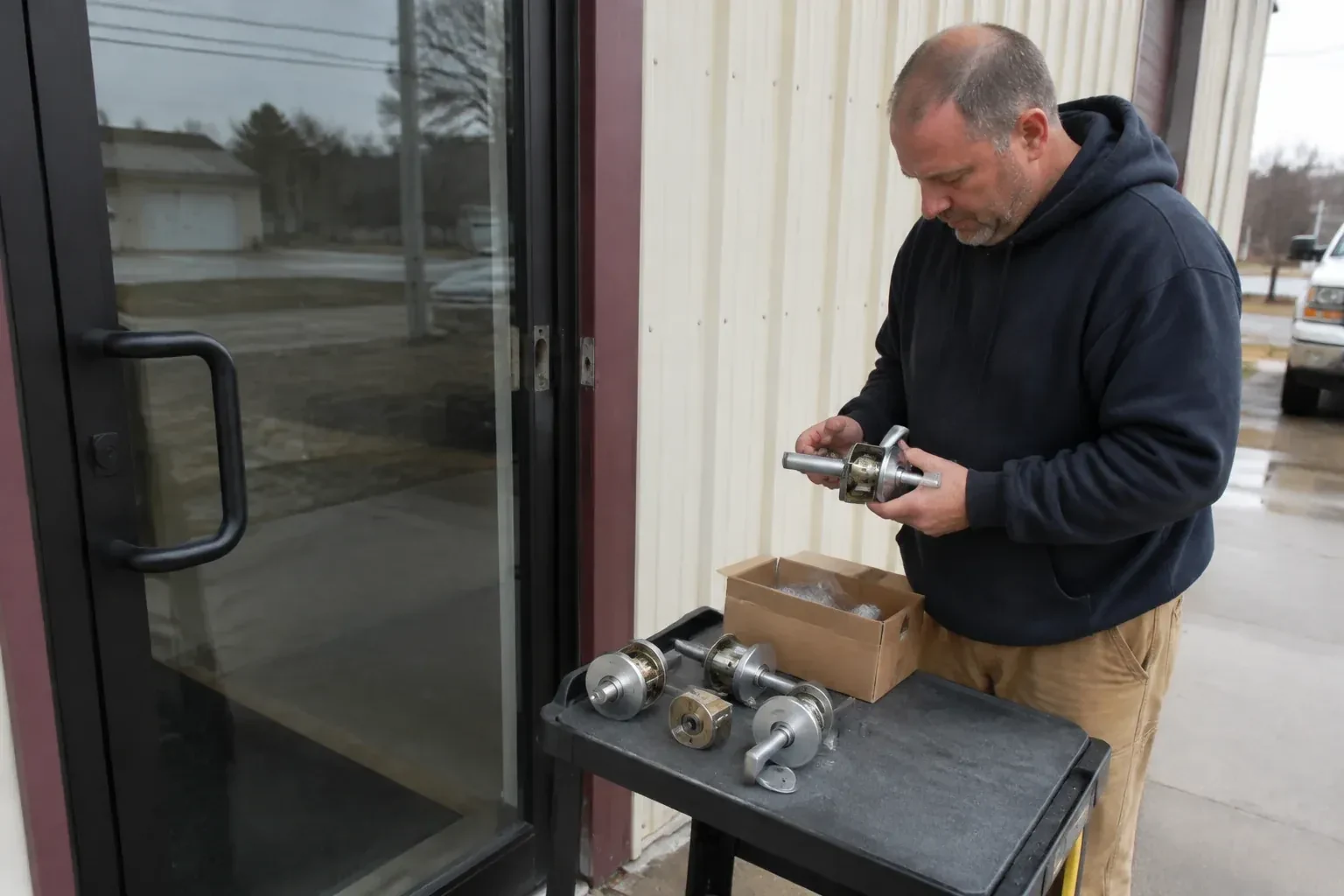
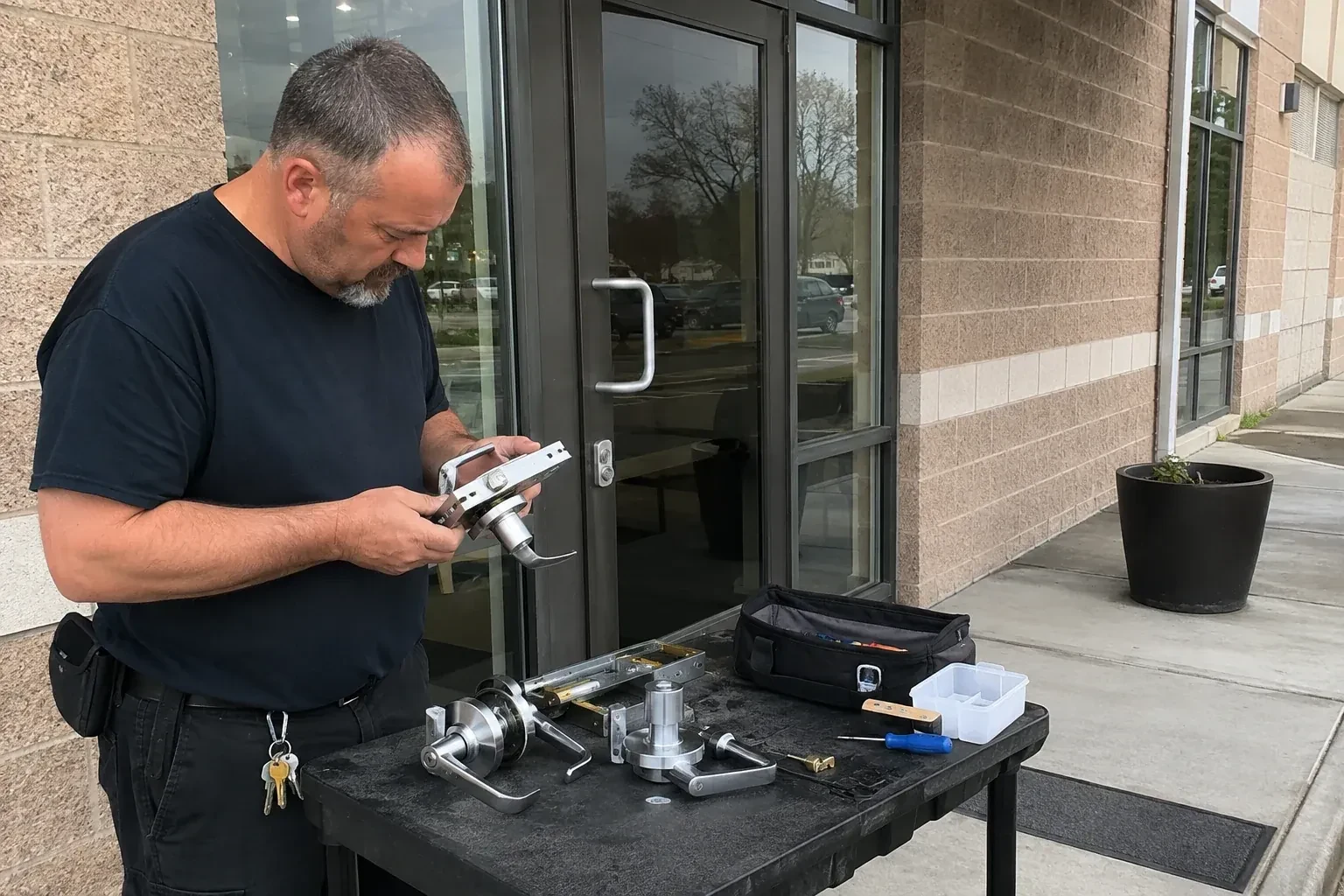
- Mortise lock body
- Mortise prep and installation tools
- Heavy-duty cylindrical lockset
- Hookbolt and deadlatch hardware
- Electric strike
What affects the quote
Same fees day, night or weekend
1Key-control documentation
Setting up or updating a written key-control log, recording who holds which key and which doors share a system, is a small but distinct task the quote can name separately from the physical hardware work.
2Restricted or patented keyways
A restricted keyway usually costs more as hardware than a standard cylinder, and duplicate keys are controlled through the manufacturer or distributor rather than cut freely; some restricted programs require formal registration, while others control the same blanks without a signed authorization step.
3Grade and duty rating of the lock
Hardware built for higher cycle counts and rougher daily handling costs more than a lighter-duty equivalent, and the right grade for a busy delivery door is not the same as for a quiet interior office.
Commercial-Grade Lock Replacement: questions
What should I do with the old hardware once it is replaced?
That is entirely your choice. Some businesses keep old hardware briefly in case a spare part is needed elsewhere on the same system, others prefer it removed from the site straightaway, particularly after a break-in where the damaged pieces are no longer wanted around. The locksmith can leave it with you or take it away, whichever you prefer.
My storefront door is aluminum and glass. Does it need special hardware?
Yes. An aluminum storefront door has a narrow stile, the vertical metal frame around the glass, that a standard mortise or cylindrical lock cannot physically fit into. These doors take a narrow-stile lock or a hookbolt built specifically for that slim profile, and matching the hardware to the frame is what lets the bolt engage the keeper fully instead of catching at an angle.
What makes a lock 'commercial-grade' rather than a residential one?
Commercial-grade hardware is built for far higher cycle counts and rougher daily handling than a home lock ever sees: heavier internal components, a lock body and strike designed to take repeated forceful use, and often a rating tied to an industry grading system that measures cycles and impact resistance. A residential deadbolt fitted to a busy business door tends to wear out well before its time because it was never built for that volume of use.
Commercial Locks
Commercial-Grade Lock Replacement near you
Lock work in Birchwood is rarely just one thing. A lockout often reveals a worn cylinder; a rekey is a good moment to fix a strike that never lined up. The services below are described one at a time, but a locksmith at your door will happily point out anything else worth doing while he is there.